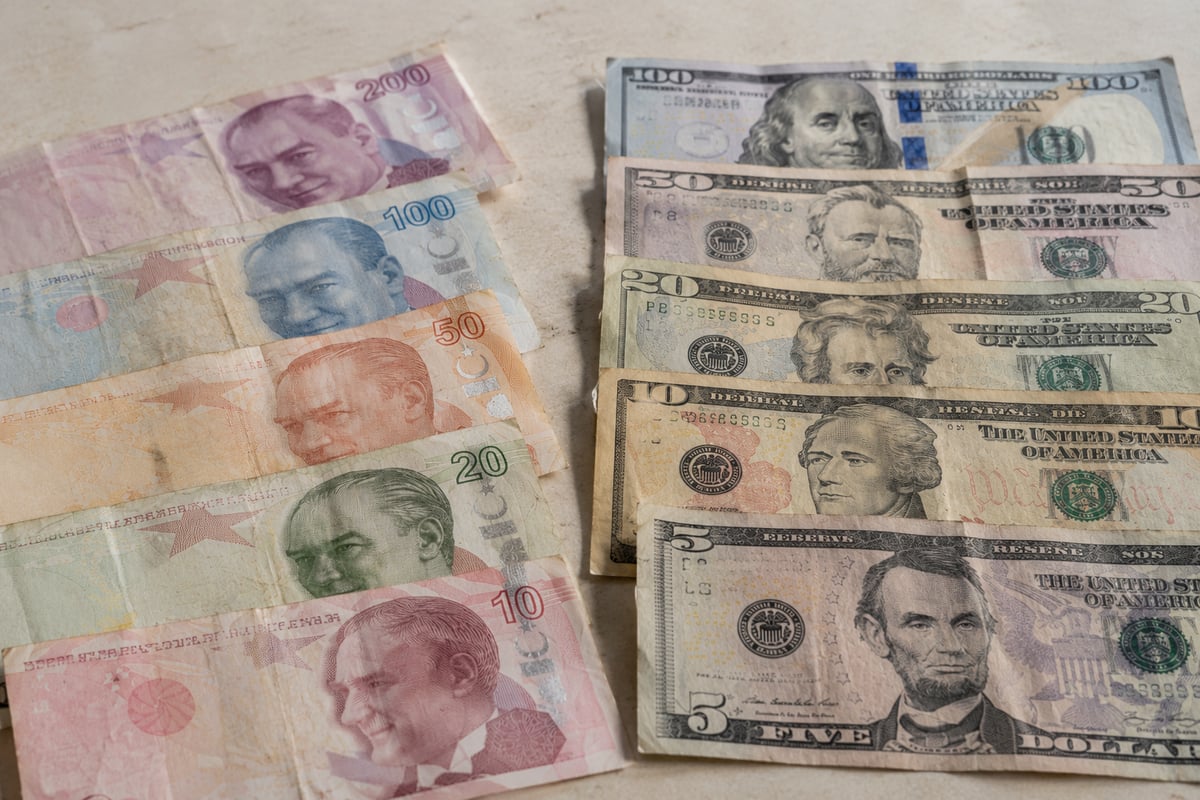
An ATM is not the only way to end up holding lira, and for anyone arriving with dollars it isn't necessarily the obvious one. Turkey has a dense network of licensed exchange offices, bank counters that will do the same job, and a set of customs rules on carrying cash that most travelers get backwards.
How an exchange office works
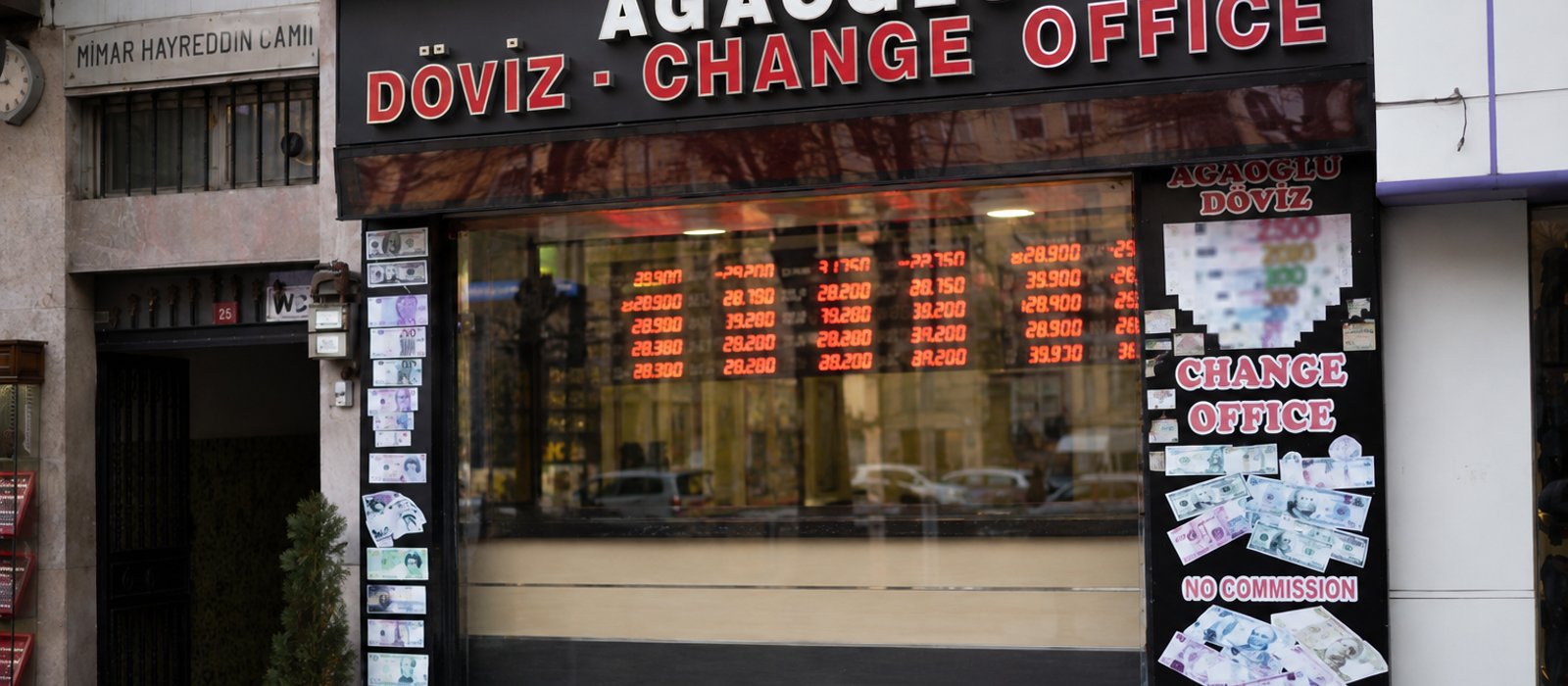
Licensed exchange offices display separate buying and selling rates, and the spread is the difference between the two. Commission practice varies by office and is not uniformly prohibited or required by a single published rule.
The two-rate display is the mechanism worth understanding, because it's where the cost lives. An office buying dollars at one rate and selling them at another earns the gap, and that gap is the price of the transaction whether or not anything is called a fee.
Which means "no commission" — a common sign — describes only one of two possible charges. A wide spread with no commission can cost more than a narrow spread with one.
How the spread compares between offices, or between an office and an ATM, isn't published anywhere. No official comparative data exists, and any general claim about which is better would be an assertion rather than a fact.
Bank counters and airports
Banks perform the same function, and what a Turkish bank counter asks of a foreign customer isn't documented in any official source — no uniform list of required documents was found. In practice a passport is the baseline expectation for an identified transaction anywhere.
The airport-versus-city question is the same story. There's no official comparative rate table, so the widely repeated claim that airport rates are worse is folk knowledge rather than a published fact. What can be said structurally is that airport exchange operates under different conditions from city exchange — captive demand, higher costs, limited competition — and that those conditions are the kind that generally shape a spread.
That's a mechanism, not a measurement, and it's worth being clear which one it is.
Bringing cash in — the rule everyone reverses
This is the part most travelers have the wrong way round, and it's worth reading carefully.
Import of foreign currency into Turkey is free. For export — taking cash out — amounts exceeding 10,000 euros or equivalent in foreign currency, or exceeding 185,000 Turkish lira, must be declared to customs on the official cash declaration form.
Coming in: no limit, nothing to declare. Going out: a threshold, and a form.
The reversed version — that you must declare above ten thousand on arrival — circulates widely and is stated confidently in plenty of travel writing. It describes the rule in the wrong direction, and the direction is the whole substance of it.
Two separate thresholds also apply, one for foreign currency and a different one for lira, so a mixed holding is measured against both.
Leftover lira
Turkish lira may be taken out of Turkey subject to the same declaration threshold — above 185,000 lira requires declaration — and conversion back to foreign currency is available at banks and licensed exchange offices.
So there's no prohibition on leaving with lira, and no requirement to convert before departing. For ordinary amounts the question is purely practical: lira is not readily exchangeable outside Turkey and its value against the dollar moves, which makes leftover notes a currency position rather than a souvenir.
Converting back engages the same spread as converting in, from the other side.
The choice, laid out
Three routes to holding lira, with genuinely different cost structures:
An ATM — where the Turkish operator's charge can be a percentage, as covered in what a Turkish ATM withdrawal actually costs, stacked with your issuer's fee and the exchange margin.
An exchange office — where the cost is the spread, possibly plus commission, and where you must already be holding dollars.
A bank counter — the same transaction with an identification step and, in practice, opening hours.
Each has a different shape, and the first two respond differently to the amount involved. Carrying dollars in to exchange also has a cost that doesn't appear in any rate: it's cash in a pocket for the length of a trip.
Working out which route suits a particular trip — against withdrawal charges that scale, spreads that don't publish, and an amount of cash determined by how you travel — is exactly what these guides supply the parts for rather than settle. Turkey, Worked Out settles it.
FAQ
Do I have to declare cash when arriving in Turkey?
No. Bringing foreign currency in is free; it's taking cash OUT that must be declared above 10,000 euros equivalent or 185,000 lira. The commonly repeated version has the direction reversed.
How do exchange offices make money?
Through the spread between their buying and selling rates, with commission practice varying by office. "No commission" describes only one of the two possible charges.
Are airport rates worse than city rates?
No official comparative data exists, so that's folk knowledge rather than a measured fact. Airport exchange does operate under conditions — captive demand, limited competition — that generally shape a spread.
Can I take leftover lira home?
Yes, subject to declaration above 185,000 lira, and conversion back is available at banks and licensed offices. Lira isn't readily exchangeable outside Turkey.
Should I bring dollars to exchange?
That depends on your issuer's fees, the spreads you meet, and how much cash your trip actually needs — and carrying cash has a cost that appears in no rate. The components differ in shape, so the answer isn't general.