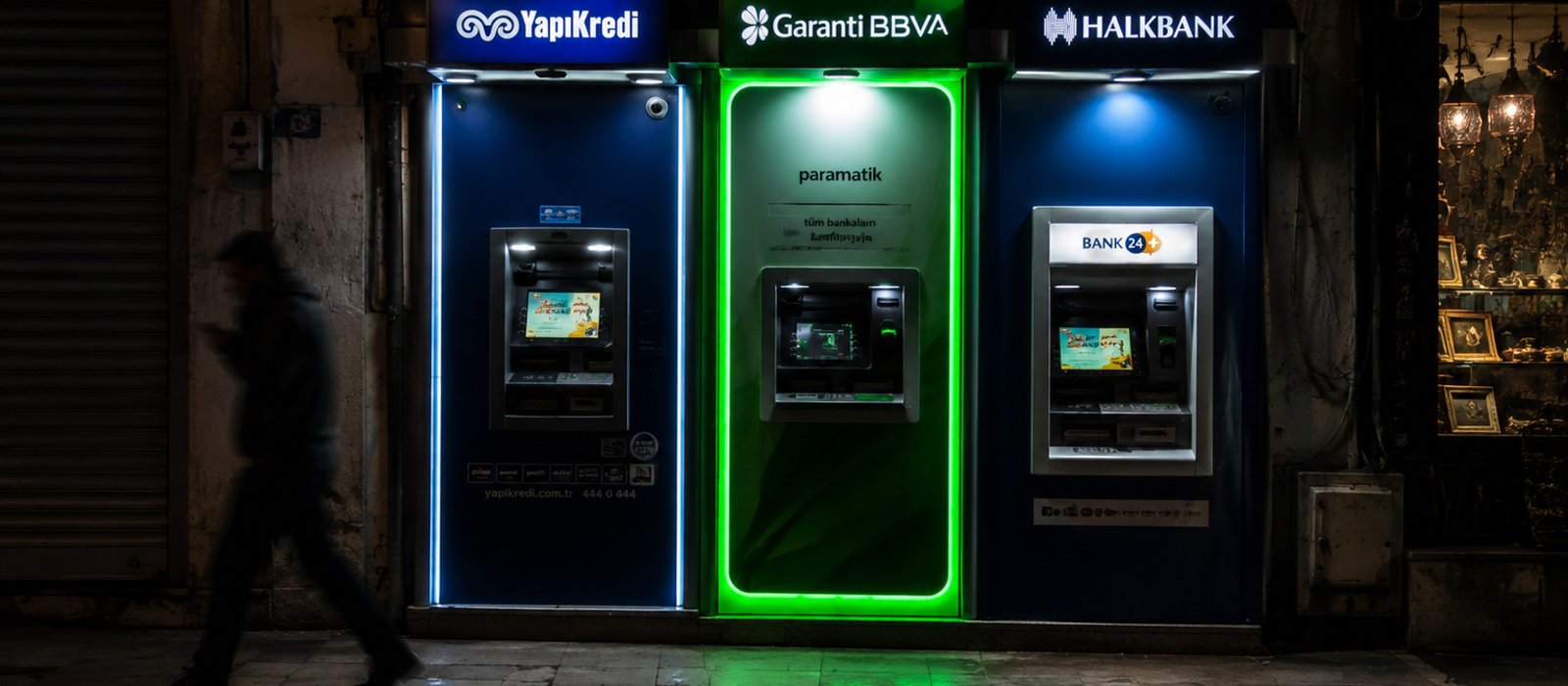
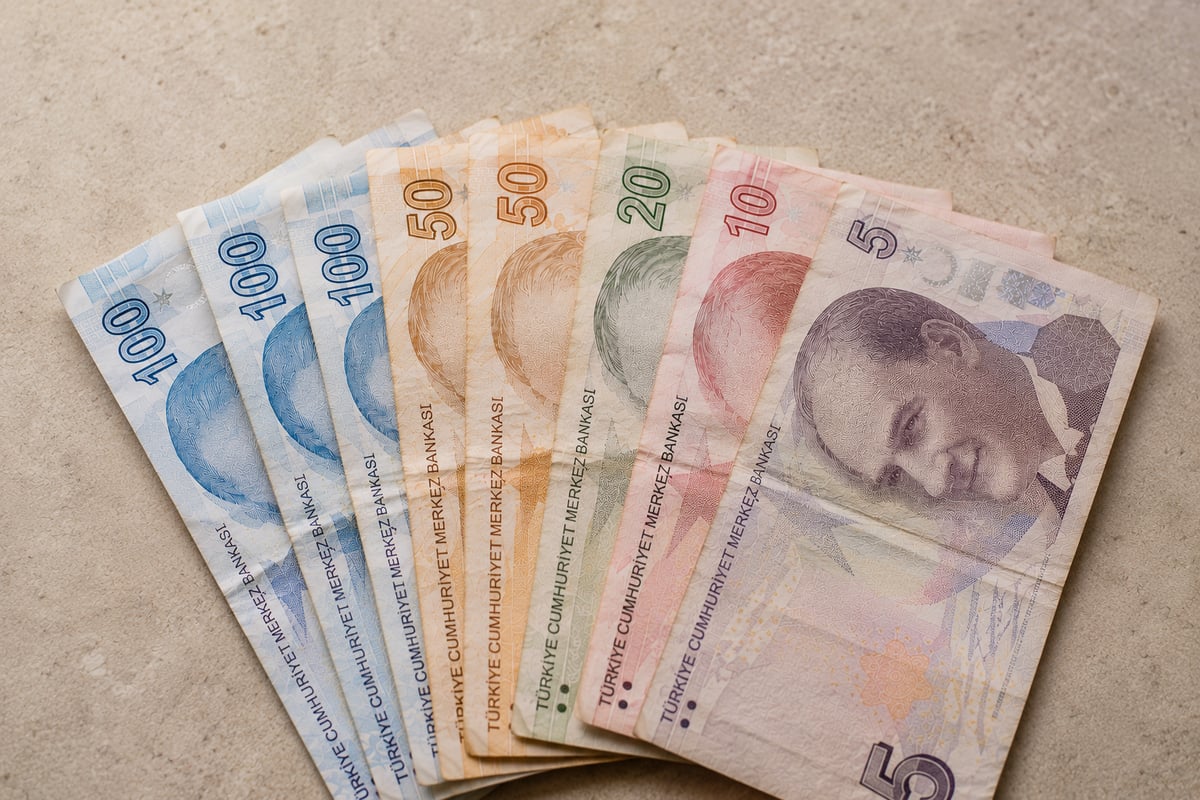
Take money out of a Turkish ATM and the amount that leaves your account is not the amount that appears on the screen. Three or four separate charges are applied by three or four separate parties, none of whom mentions the others, and one of them is far larger than most travelers imagine.
Here is what each layer is and who applies it.
The Turkish bank's charge
This is the layer that surprises people, because in most of the world it's a small flat fee.
Akbank publishes a fee for withdrawals by foreign cards at its domestic ATMs of 12.50% to 25.00%, excluding banking transaction tax. Other major Turkish banks' published ATM tariffs primarily cover Turkish cards, and no uniform national foreign-card operator fee is published.
Read that as a percentage, because it is one. Not a flat charge, not a couple of dollars — a proportion of whatever you withdraw, published on the bank's own tariff page.
Two caveats matter. That figure is what one major bank publishes, not a national rate; other banks' pages don't state an equivalent foreign-card surcharge at all, which is not the same as saying they don't charge one. And it excludes the banking transaction tax applied on top.
What follows structurally is that the Turkish layer scales with the amount, while the layers below it mostly don't. Those two behave differently as the withdrawal changes size, and that difference is the whole arithmetic.
Your own bank's charge
US issuing banks commonly apply a fixed per-withdrawal fee and/or a percentage foreign-transaction fee on cash withdrawals abroad, with the exact structure set by each issuer.
No figure appears here because there isn't one to give — this is per-issuer, it changes without notice, and it's the one layer you can establish exactly before leaving, from your own account terms.
The structural point is the same as above: a fixed fee behaves one way against withdrawal size and a percentage behaves another. Which one your issuer uses, or whether it uses both, determines how its charge moves.
The exchange rate itself
The exchange rate applied to a card withdrawal is set by the card network and/or the issuing bank, is separate from any ATM operator fee, and appears as a markup over the wholesale rate.
This is a cost even though it never appears as a line item. It's embedded in the rate, which is why a withdrawal can look fee-free and still be expensive.
The fourth layer, which is optional
Dynamic currency conversion is offered at some Turkish ATMs and card terminals: the machine presents a choice of billing in local currency or your home currency, with the conversion rate set by the DCC provider rather than your card issuer.
Accepting it substitutes the machine's rate for your issuer's. Turkey's currency handling generally is covered in the site's money guide; what's worth registering here is simply that this is a distinct fourth layer, presented as a convenience, applied by a party you have no relationship with.
Limits, and how they interact
Per-withdrawal and daily cash limits at Turkish ATMs vary by bank and card type; foreign card limits are often lower than domestic ones and are set by the issuing bank.
That's observed practice rather than a published rule, and no official source states limits for foreign cards. It matters because a limit interacts with the fee structure: where a charge is fixed, the number of transactions determines the total; where it's a percentage, the number of transactions is irrelevant and the amount is everything.
With a percentage charge on one side and possibly a fixed charge on the other, those two forces don't point the same way.
Putting the layers side by side
A single withdrawal can engage all of these:
The Turkish operator — potentially a percentage, published by at least one major bank in double digits.
Your issuer's fee — fixed, percentage, or both, knowable in advance from your own terms.
The exchange margin — embedded in the rate, invisible as a line.
DCC — only if accepted at the screen.
Only the second is genuinely knowable before you travel. The first varies by machine and is published by some banks and not others. The third doesn't itemise. The fourth is a choice made in a few seconds at a keypad.
Why this is worth doing arithmetic on
In a country where card acceptance is broad but cash still matters in specific settings — covered in where cards work in Turkey and where they don't — the number of times you need an ATM isn't fixed by the trip. It's shaped by how you spend.
And because the charges have different shapes, the same total amount of cash can cost noticeably different sums depending on how it's drawn. That is arithmetic rather than advice, and it's arithmetic that depends on which issuer you hold and which machine you stand at.
Working out what that means for a specific trip — with your issuer's terms, your spending pattern and the machines available — is exactly the calculation these guides supply the components for. Turkey, Worked Out performs it.
FAQ
What does a Turkish ATM charge a foreign card?
Akbank publishes 12.50% to 25.00% excluding transaction tax for foreign-card withdrawals at its ATMs; other banks' published tariffs cover Turkish cards and no national figure exists. It's a percentage, not a flat fee.
How many charges are there in total?
Up to four: the Turkish operator's, your issuer's, the exchange margin embedded in the rate, and dynamic currency conversion if you accept it at the screen.
What will my own bank charge?
A fixed per-withdrawal fee, a percentage foreign-transaction fee, or both — set by each issuer. It's the one layer you can establish exactly before travelling, from your account terms.
Is there a withdrawal limit?
Limits vary by bank and card type, and foreign-card limits are often lower and set by the issuing bank. No official source publishes them for foreign cards.
Does the fee depend on Visa versus Mastercard?
Nothing published differentiates the two on the same Turkish machine. That's worth stating plainly rather than assuming, because it does differ in some other countries.